Michael Perlman, writer/director of From White Plains, sat down with Adam Rothenberg of CallMeAdam.com to talk about the play, inspiration, and the creative process. Check it!
Michael Perlman is a NYC based director and playwright who earned his MFA in Directing from the Brown University/Trinity Rep MFA Directing Program. He won the Motif Award for Best Director for Hamlet at Brown/Trinity Rep MFA Program and his one-person show Flying on the Wing was presented at the New York Fringe Festival, where it was the winner of Outstanding Solo Show of 2006. Michael is proud to be a member of SDC and a Drama League Directing Fellow.
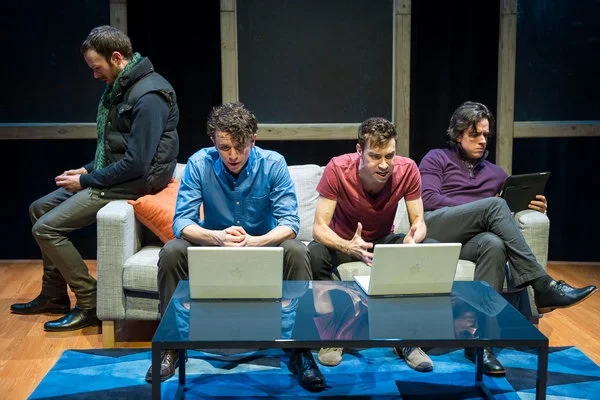
After it’s premiere at La Tea Theatre this past Spring, Fault Line Theatre’s presentation of Michael’s new show, From White Plains, (nominated for a GLAAD Media Award for Off-Off-Broadway Theater and for New York Innovative Theater awards for Outstanding Premiere Production and Outstanding Full-Length Script) about the lasting effects of gay bullying, is now playing at The Studio Theatre at Pershing Square Signature Center in New York City (480 W. 42nd Street, between 9th & 10th Avenue) through March 9. Click here for tickets!
For more on Michael be sure to visit http://www.michaelsperlman.com!
1. Who or what inspired you to become a playwright and director? That’s a really good question. I was drawn to theatre from a very young age. I had a lot of medical troubles when I was younger and theatre became a way for me to sometimes be a different person. I think the ability to tell stories in a way that is immediate allows the transportation of the body and not just the mind. It also allows the world to shift for people and see the world in a different way from different perspectives. It enables them ask questions they might not have asked before. I think that holistic experience is what kept me directing and writing. Someone once described marriage in a way that you have to wake-up and decide to be married to the person. I feel a life in the theatre, which I’ve chosen, is similar. You to wake-up everyday and decide, “Today I’m going to be a theatre artist.” I don’t think my decision to be in theatre happened in a moment, but it’s been a continual one for me.
2. Who haven’t you worked with that you would like to? There are many people I’d like to work with. There are many directors I admire and have a huge respect for. I’m a big admire of Mike Nichols who is just able to get to the heart of the story and characters. Whether it’s drama or comedy, he just gets that theatre is about people. I think Daniel Sullivan is similar. I feel John Doyle’s direction comes from the approach that it’s all about the actor on stage making the story happen. John and David Cromer understand that emotion and sentiment are important, but it’s not about the manipulation of sentimentality, it’s about the truth of it.
I don’t even think I could start talking about all the actors I want to work with. I love actors, so anytime I see a performance I love, I just want to work with that person.
3. What made you want to write From White Plains? Aaron Rossini and Craig Wesley Divino, Co-Artistic Directors of Fault Line Theatre, approached me to direct a new play. We had one play we wanted to do and another theatre picked it up and then there was another play we wanted to do and the writer’s agent wanted to wait to see what other theatres wanted to do it because Fault is still a relatively new theatre company. It started to feel like we were waiting for someone to say yes to us, so we decided to make a play happen ourselves. That, for me, is how the inspiration came about to write From White Plains. The play was also inspired partly by the actors I wanted to work with which shaped the characters and situation. It was also from reading the paper everyday, the continued conversations I’ve had about gay bullying and its affect on people, the fact that all these kids were deciding to end their life, and the outpouring of support from the “It Gets Better” project. It felt to me like this subject was such a great conversation, but it also becomes so black and white. Again, I’m very interested in discovering how one can see the world from different perspectives and so I approached this play as to how can we fully explore the gray area of this topic. How can we get every side to see the other side’s point of view and not to condemn or advocate that it’s okay to bully?
4. What do you hope audiences come away with after seeing the show? Audiences who have seen the show already, come back to me and tell me the experiences of their own lives, whether they’ve been bullied or been the bully themselves. A lot of people have asked questions about experiences in my life or in the actor’s life. The conversation goes way beyond the play. It’s always nice to have the “The play was great” conversation or “Wow, that was so moving,” and I will never begrudge someone for telling me I’ve done a great job, but it’s so much more rewarding for me to know that people have seen this play and that it started a conversation within themselves and others about their own life. It’s nice to see that they are seeing things from a different perspective or seeing their own perspective with a little more complexity. Having these people walk away having those conversations then that’s the theatre I want to be making.
5. From White Plains was presented as a showcase at La Tea Theatre this past Spring and is now premiering Off-Broadway at the Pershing Square Signature Center. What went through your mind when you found out a transfer was going to happen? Without trying to sound smart, it was “Oh yeah. Oh shit.” It was that exact progression. I was happy the show was having more of a life, but that also meant I had to go back and make it better. Hopefully, that’s what I’ve done. So many people said, “We’d love to bring so and so this, when can we see it again?” It’s a great feeling to know this show had that kind of affect on audiences. The main thing I’m excited about is that more people get to see the show.
6. How do you feel the play and cast have grown since this first presentation? I think there was a lot of flying by the seat of our pants in the last run. We were writing the play as we were putting it up. We didn’t know if it would work until there was an audience. I think now we can trust that the play works rather than be outside and inside it at the same time, we can all just be inside of it. We know the story we are telling. The show has a little more breath in it and it’s a little more grounded. I just hope we can make it deeper and richer. It’s been months since we’ve done the show and we’ve had time to sit and look at what was originially a placeholder and what we want the story to be. We’ve all had that much more life experience and every one of our life experiences contribute to who we are as artists, so those situations will change us, and they’ve already changed the play. So, there is more now for us to use to tell our story.
7. From White Plains is about taking responsibility for past actions, in this case, specifically bullying. If you feel comfortable speaking about it, have you had any specific incidents with bullying? Do you have any past actions that you’ve needed to take responsibility for? I was very lucky in that I never really got bullied too much when I was younger. Generally the bullies would defend if another bully would try to come at me. I was a short kid with a raspy voice and effeminate mannerisms and I just knew that I wasn’t going to survive very long if I didn’t figure out how to make people like me and be my friend and be on my side. So from a very young age, I learned how to charm people. While I wasn’t physically bullied, there were subtle ways in which I was bullied. For instance, people would use the word gay in a very derogatory way in front of me and that affected me.
I do have things in my past that I’ve done and feel bad about. Everyone who is scared of being on the outside has moments where they are happy to be on the inside. I’m sure I’ve laughed at a joke at someone else’s expense. I remember one time at camp there was this kid in our group of friends that we ragged on and one day he was like, “You know, it’s not really fun to hang out with you guys anymore, so I’m not going to” and he walked away. In that moment, I learned a lot from him. I still feel bad about picking on him. It was not the intended affect to make him not want to hang out with us, but that clearly became the affect.
I think doing this play has made us and I hope the audience to think, “Wow, that one time I laughed at someone affected that person and I don’t have to beat myself up about it, but it did affect them.” There is a ripple effect to everything we do.
8. What is your favorite part of the creative process in writing and directing a show? Definitely the collaboration. I do theatre because I get to do it with other people and I get to be in a rehearsal room and we figure it out all together and then do it live for an audience, which I consider part of the collaboration. I love the human interaction.
9. What have you learned about yourself from being a playwright and director? I’ve learned to give up control. Doing theatre, I try to give my collaborators a skeleton to work in and then trust that they know how to go there with me. The more control I give up, the more fun I have and the prouder I am of the work.
10. What’s the best advice you’ve ever received? I’ve received a lot of advice. One of my teachers said to me once, “Put what you love on stage.” It’s a great reminder to trust I have good taste so therefore I can make the show something I love. Instead of worrying who will like it, just know I created this for a reason, and I have to trust that my enjoyment of it is enough and then the audience will too.
I also love the line in Sunday in the Park with George, “Anything you do let it come from you, then it will be new.” I try to be as true to that as possible.
BONUS QUESTIONS:
11. Favorite way to spend your day? Relaxing, especially during this process because I’m writing and directing, so my brain doesn’t really get to shut off in that I’m always thinking about the play. I like to give myself some time on my day off to shut off. One of my teachers calls this “Me time” and I think that’s perfect.
12. If you could have any super power, which one would you choose? I would want to be able to transport myself instantly.
More on Michael:
Other directing credits: A Christmas Carol, The Mourner’s Bench (Trinity Rep), Time of Your Life, Uncle Vanya, A Doll’s House (Brown/Trinity MFA Programs), Velocity of Autumn (Boise Contemporary Theater), Oklahoma (Maples Rep), Dog Park and Life Science (Brown/Trinity Playwrights Rep), We Are Proud to Present a Presentation…and Exquisite Corpse (New Plays Festival), Love, I Hear (Stephen Foster Productions), Iphigenia and Other Daughters (Temporary Theatre Company), The Last Five Years (Stamford Center for the Arts), Winnie-the-Pooh (Hangar Theatre Kidstuff), Emperor of Ice Cream…and Romeo and Juliet (Hangar Theatre Lab Company). Michael is proud to be a member of SDC and a Drama League Directing Fellow.
View original article.